
Natural energy air conditioner
Ultra-energy-efficient natural cooling system: This system utilizes natural energy to achieve high energy efficiency and a comfortable environment in large spaces such as factories, warehouses, and livestock facilities (especially pig farms).
Utilizing natural energy, which is renewable energy,
Electricity bill reduced to less than 1/10!
Overwhelming performance thanks to our unique multi-stage heat exchange system
Groundwater air conditioner using renewable energy *Developed by our company

By using groundwater heat, air conditioning costs can be reduced by more than 901 TP3T.
Groundwater air conditioners that use renewable energy are energy-saving air conditioning systems that use the temperature of groundwater without using a heat pump. The "groundwater direct cooler" uses the groundwater temperature of around 15°C for cooling as is, demonstrating ultra-energy-saving performance that cannot be compared to air conditioners.
Groundwater is passed through a drip-type pad structure or a radiator-type stainless steel high-durability heat exchanger to directly cool the air. The electricity bill for the fan and pump alone will provide approximately 20°C of cool air. Power consumption is less than 1/10 of that of an air conditioner, achieving overwhelming running costs.

Overwhelming energy-saving performance compared to general air conditioners
As you can see from the comparison with ten 10 horsepower air conditioners, cooling costs were reduced by 90%, resulting in a savings of 3,705,480 yen per year.

Utilizing stable groundwater heat throughout the year
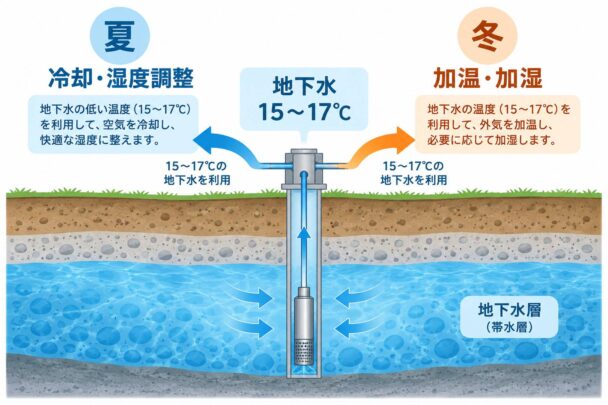
In many areas, groundwater maintains a stable temperature of around 15-17°C throughout the year.
AGE utilizes this naturally occurring heat in both summer and winter.
In the summer, humidity is also regulated by using a system that cools the air by utilizing the low temperature of groundwater.
In winter, the cold outside air is heated using the heat from the groundwater, and humidification can be added as needed.
Groundwater is not just a heat source for air conditioning; it's a natural energy source that can be used throughout the year.
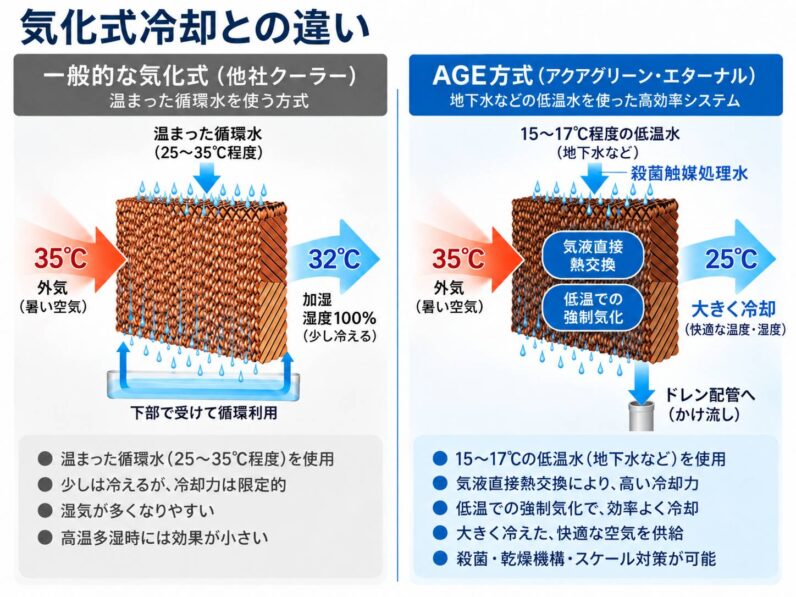
What makes it different from a typical evaporative air cooler?
Typical evaporative air coolers cool the air by circulating water and causing it to evaporate, using the heat of vaporization to cool the air.
While effective for home use, it is not suitable for large-scale factory equipment.
- The temperature of the circulating water rises.
- It may not cool down sufficiently in hot and humid conditions.
- Prone to humid winds
- Water becomes concentrated, making it easier for scale and dirt to form.
Mold is more likely to grow in wet areas.
These kinds of problems can occur.
AquaGreen Eternal combines direct gas-liquid heat exchange using low-temperature water with forced vaporization at low temperatures.
moreover,
• Use sterilized water
・Catalyst treatment as needed
- A mechanism to dry wet parts after operation has stopped.
By combining these elements, it makes long-term operation easier.
The difference from a system that uses only a radiator and groundwater.
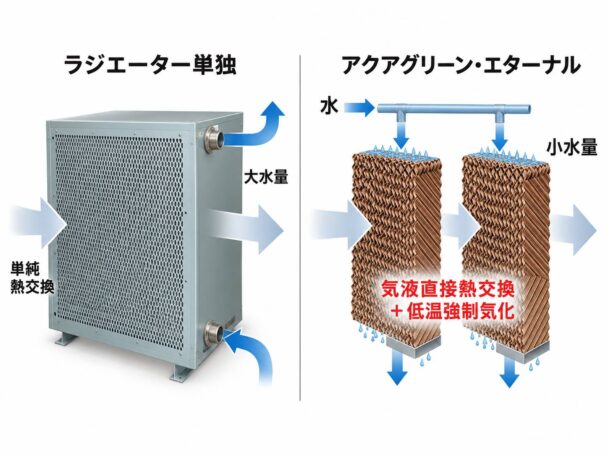
There are also air conditioning systems that use groundwater flowing into radiators and blowing air onto their surface.
This can also cool things down, but it's basically just simple heat exchange, so it requires a large volume of water.
AGE aims to achieve greater heat exchange with less water by combining direct gas-liquid heat exchange with forced vaporization at low temperatures.
Furthermore, while copper is commonly used in general radiators, Aqua Green Eternal employs highly corrosion-resistant materials such as stainless steel for the parts that come into contact with groundwater.
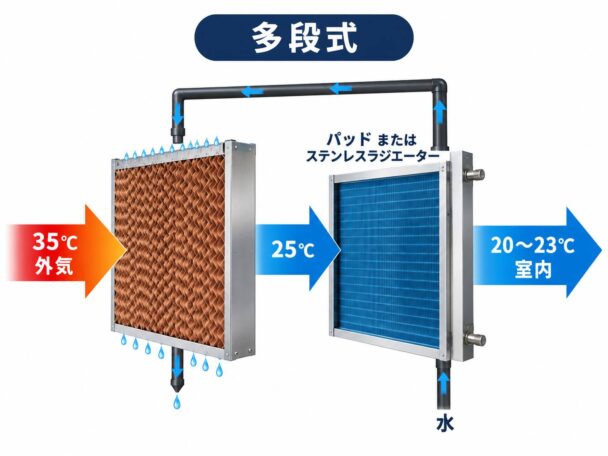
One of the features of AGE is its multi-stage system, which processes air in stages rather than just one.
First row
A large amount of air is passed through a porous pad that has been moistened with cold water.
Here, forced vaporization at low temperatures and direct gas-liquid heat exchange occur simultaneously.
Under typical conditions, the temperature can be lowered to around 25-27°C when the outside temperature is 35°C.
There are two ways to proceed to the second stage.
A: Pad + Pad
The air, which has already cooled and become humid in the first stage, is then passed through a pad that has been moistened again with cold water.
In the second stage, normal vaporization becomes less likely, and direct gas-liquid heat exchange is the primary mechanism at work.
B: Pads + Stainless steel radiator
By placing the radiator at the end of the system, water and air do not come into direct contact, allowing for further cooling and dehumidification while minimizing additional humidification.
The water is used in the following order: the coldest water goes first to the radiator, and then the water from its outlet goes to the front brake pads.
This is the idea of using a single bottle of cold water efficiently and without waste.
During heating, hot water is circulated to the radiator, and humidification can be performed in the preceding stage as needed.
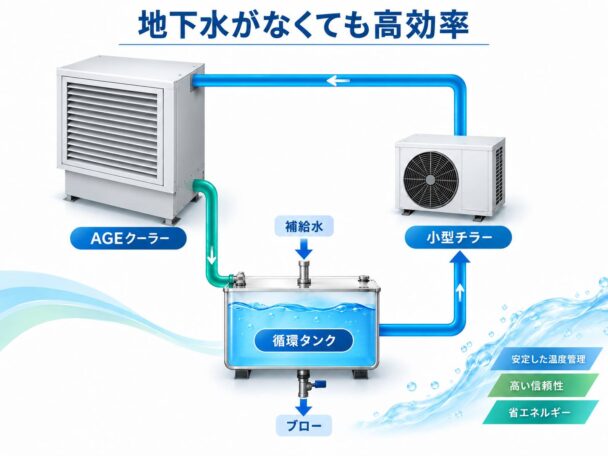
It can be used even without groundwater.
AGE is not exclusively for groundwater.
In areas without groundwater, or where the groundwater temperature rises during water transport, a circulation tank plus a small chiller is used.
Because our system requires less water, we can adjust the water temperature to around 15°C using a small chiller instead of a large refrigeration unit.
The water is circulated, and only small amounts are blown out to add replenishment water to prevent concentration.
Even without groundwater, our principles can be utilized by "creating a low-temperature water environment similar to that of groundwater."
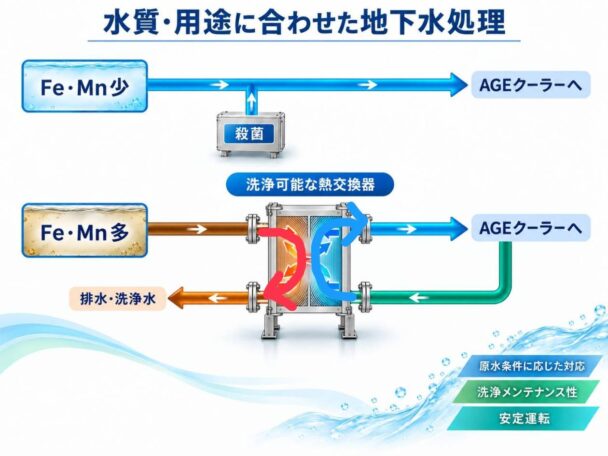
Keep the approach to groundwater treatment for air conditioning simple.
With AquaGreen Eternal, there is no need to treat groundwater with the same advanced treatment as drinking water.
Basically,
- Components that precipitate when exposed to air, such as iron and manganese.
Turbidity
・Sterilization
We will check.
If the iron and manganese content is low, sterilized groundwater can be used as is.
In cases where there are many, instead of removing them all with advanced processing,
Using an easy-to-clean heat exchanger, it receives "only heat" from groundwater.
There is a method.
In the basic method of using groundwater in a continuous flow system, the water is not repeatedly concentrated, which reduces the likelihood of scale formation due to calcium, magnesium, and other elements.
Only in the case of a circulating system, a small amount of blow-drying is performed.
Sending a large amount of air over long distances.
Our basic equipment was developed from the outset with large spaces such as factories, warehouses, and livestock facilities in mind.
Instead of blowing out a small amount of air at a very low temperature like an air conditioner,
It delivers a slightly cooler airflow with a large volume to reach far distances.
That's the idea.
As a typical guideline,
Cooling capacity: Approximately 50kW, equivalent to 16 horsepower.
・Air volume: Approx. 200m³/min
Wind reach: Approximately 20m
- How to use it to process approximately 150-200 square meters with one unit.
There is.
By appropriately positioning multiple units, large spaces can be managed.
The important thing is to cool the incoming air.
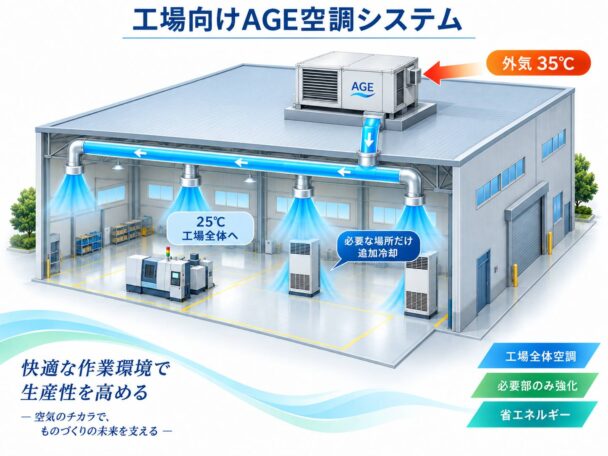
A particularly effective method in factories is to treat the outside air on the intake side.
for example,
In an environment with an outside temperature of 35°C, the large volume of air supplied to the factory is cooled to approximately 25°C.
Instead of letting 35°C outside air directly into the factory, the air is first cooled before being introduced, significantly reducing the overall cooling load on the factory.
When combined with existing air conditioners, it's possible to implement a hybrid operation that uses a large volume of incoming air for cooling, plus precise cooling of only the necessary areas with air conditioners.
This concept can also be applied to factories, livestock facilities, data centers, and other similar facilities.
Main unit list
■ Drip-type groundwater air conditioner DCD series (plastic body)

■ Drip-type groundwater air conditioner DCS series (stainless steel body)
*Custom-made product capacity can be freely designed

■ Drip-type groundwater air conditioner DCS series (stainless steel body)
*Custom-made product capacity can be freely designed

AGE is not just a company that sells equipment. We design the optimal air conditioning and heat utilization system for each location by combining groundwater, water, air, unused heat, and existing facilities. Equipment can be supplied by AGE or manufactured by our partners. Please contact us individually for detailed capacity calculations, water quality conditions, equipment configuration, and actual equipment.
Request a catalogue
Aqua Green Eternal uses renewable energy.
We sell ultra-energy-efficient air conditioners.
inquiry
Questions about renewable energy, energy conservation, air conditioning, etc.
Please feel free to contact us.
 English
 日本語
 Tiếng Việt
 Português do Brasil