
4. The difference in power consumption between a typical air conditioner and AGE — How is it possible to achieve less than one-tenth the power consumption? Even with the same cooling capacity, the required power differs significantly.
When comparing the energy-saving performance of air conditioning systems, it's not simply a matter of looking at the temperature of the air being blown out.
How much heat is removed, and how much electricity is used to achieve that?
We need to compare these two.
For example, let's consider a typical air conditioner with a cooling capacity of 50kW.
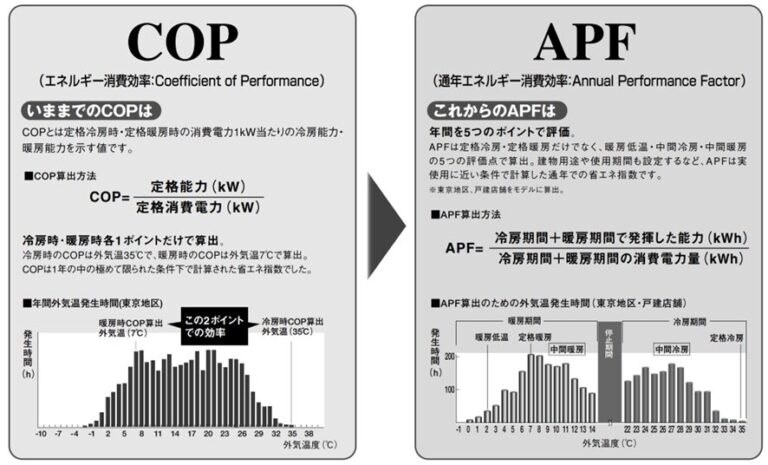
If the COP is 4, approximately 12.5kW of power is required to achieve a cooling capacity of 50kW.
Moreover, this is the value when the system is operating at a COP of 4.
If the cooling efficiency decreases due to the intense summer heat, and the COP drops to 3, the power required to achieve the same 50kW cooling capacity will increase to approximately 16.7kW.
Thus, typical air conditioners require a large amount of power, primarily from the compressor, relative to the required cooling capacity.
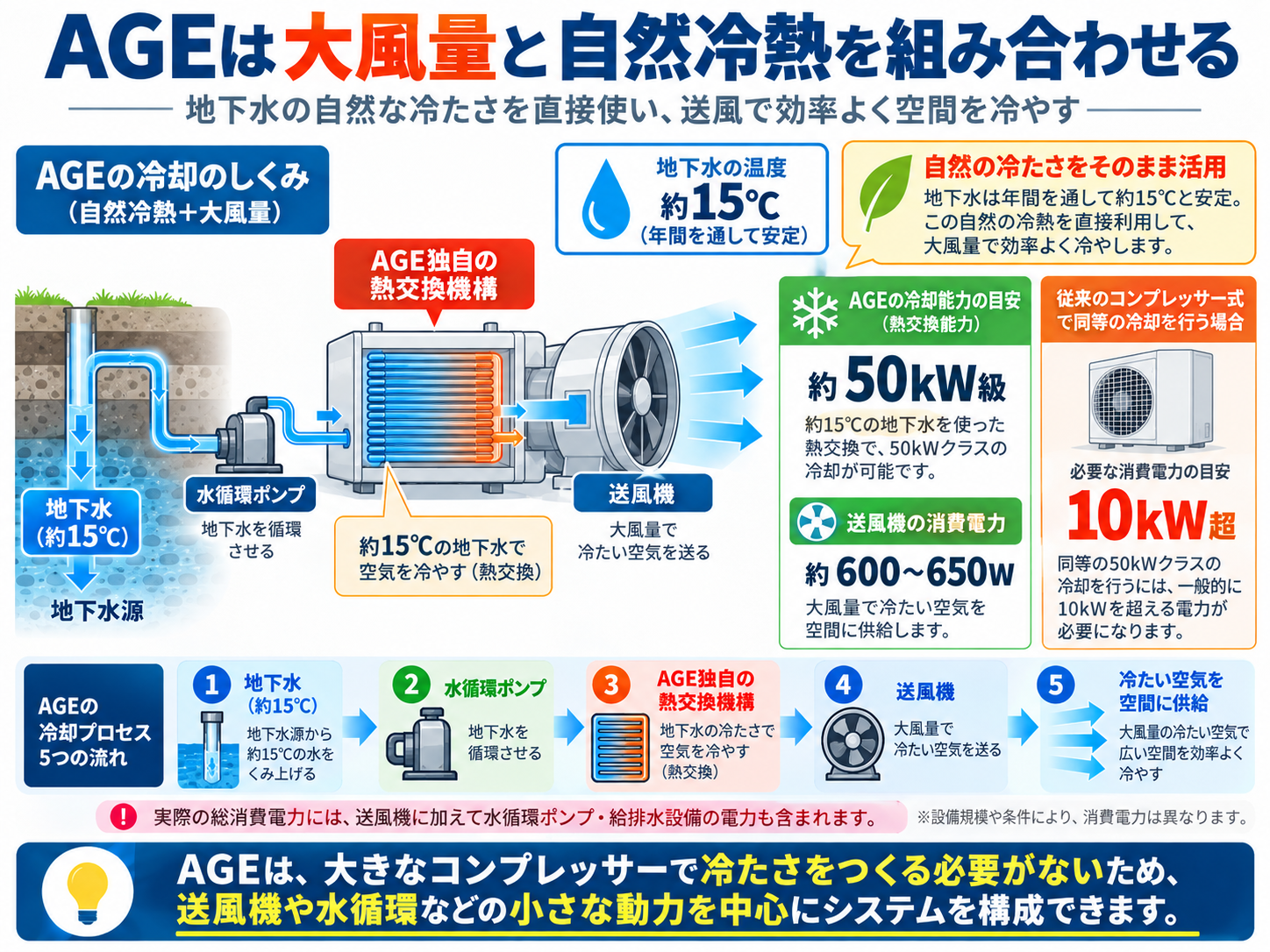
AGE combines high airflow and natural cooling.
In contrast, AGE employs a method that directly utilizes the cold energy of groundwater and other sources to efficiently cool large volumes of air.
For example, if groundwater with a temperature of approximately 15°C is available, cooling can be achieved without using a large refrigerant compressor by directly transferring that cold energy to the air.
AGE's developed high-airflow type devices utilize blowers of approximately 600-650W and have configurations that support a heat exchange capacity of approximately 50kW.
To achieve the same level of cooling capacity with a typical air conditioner, you may need more than 10kW of power to operate the compressor.
On the other hand, because AGE utilizes natural cooling, the system can be configured primarily with relatively small power sources such as blowers and water circulation equipment.
Of course, the actual total power consumption of the entire system includes not only the power for the blower but also the power for the circulation pump and water supply equipment.
Nevertheless, the fact that there is no need to generate the cold itself using a compressor is a very significant difference.
Instead of sending a small amount of cold air, use a large volume of air to carry heat.
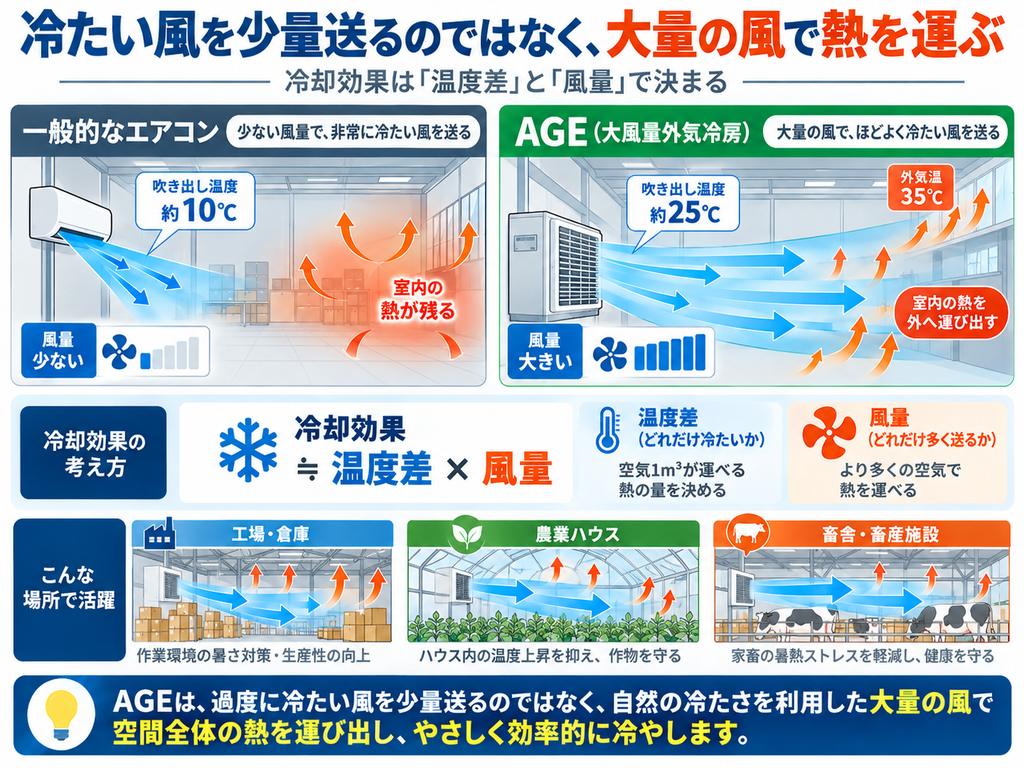
Typical air conditioners cool the room by blowing out relatively cool air.
On the other hand, with AGE, you don't need to create extremely cold air; you can achieve significant cooling capacity by simply sending out a large volume of air.
For example, if the outside temperature is 35°C, the idea is to supply a large amount of air at around 25°C from the AGE device.
Looking solely at the air outlet temperature, it may be higher than that of a typical air conditioner.
However, the amount of heat carried by the air is greatly influenced not only by the temperature difference of the air, but also by the airflow rate.
In other words, even with a relatively small temperature difference, a significant cooling effect can be achieved if there is sufficient airflow.
This concept is especially important in facilities that require large spaces and extensive ventilation, such as factories, greenhouses, and livestock barns.
Instead of creating a small amount of air at an unnecessarily low temperature, the system uses a large volume of air, utilizing natural cooling, to remove heat from the entire space.
This is a key feature of AGE's high-volume air conditioning system.
Energy saving rates vary depending on the combination of equipment.
The energy-saving performance of AGE varies depending on the conditions under which natural cooling can be utilized and the equipment configuration.
If the cooling energy of groundwater can be directly utilized, there are configurations that can reduce power consumption to less than one-tenth compared to typical compressed air conditioning systems.
Furthermore, even if groundwater is unavailable, energy efficiency can be enhanced by combining it with small chillers and other equipment.
With this type of hybrid equipment configuration, it is possible to aim for a 70-80% reduction in energy consumption compared to conventional methods, depending on the conditions.
The important thing is not to install the same equipment in every facility.
The key is to comprehensively assess available water resources, outside air conditions, required temperature, airflow, and existing equipment to select the most efficient combination.
The essence of energy conservation is to replace the work of machines with nature.
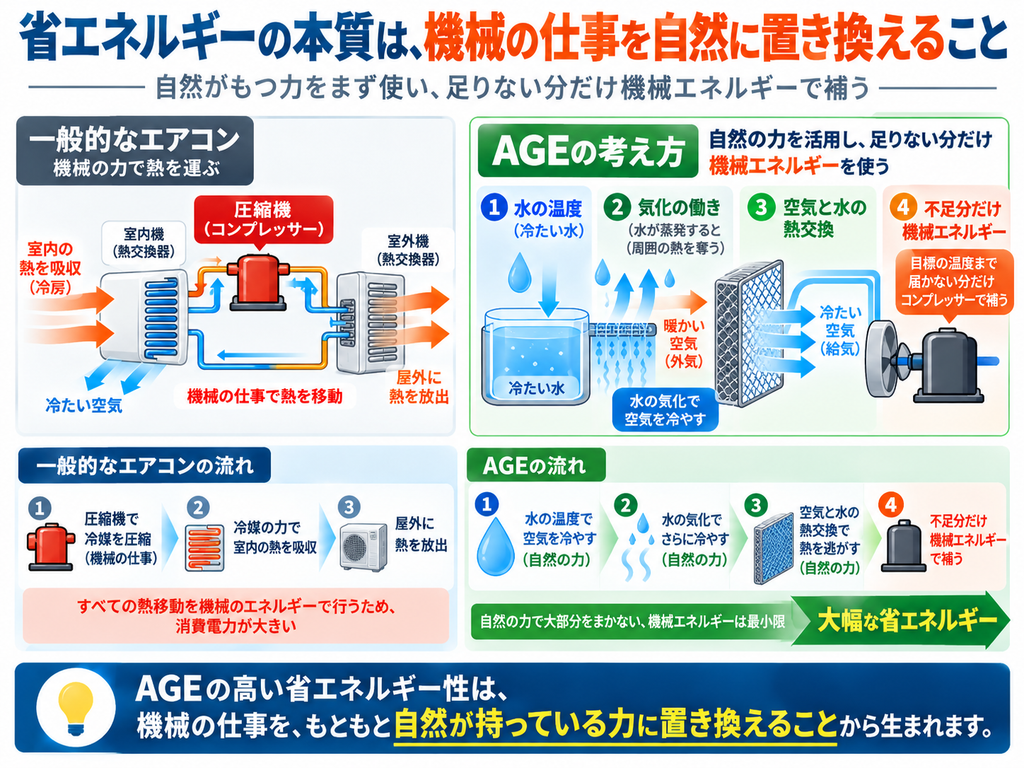
A typical air conditioner is an excellent technology that transfers heat through the action of a compressor.
However, if there is a source of natural cold energy available, it is not necessary to rely entirely on compressors.
AGE makes maximum use of the temperature of water, the process of vaporization, and the heat exchange between air and water that exist in nature.
Then, only the parts that are lacking are supplemented with mechanical energy.
Instead of relying solely on the capabilities of machines, we should utilize the power that nature already possesses.
This is why AGE can achieve significant energy savings.

 English
 日本語
 Tiếng Việt
 Português do Brasil