
5. Vaporization and direct gas-liquid heat exchange in low-temperature ranges — AGE's unique cooling mechanism
Two cooling effects are created by direct contact between water and air.
AGE's air conditioning technology has some significant features that set it apart from typical air conditioners and simple water-cooled radiators.
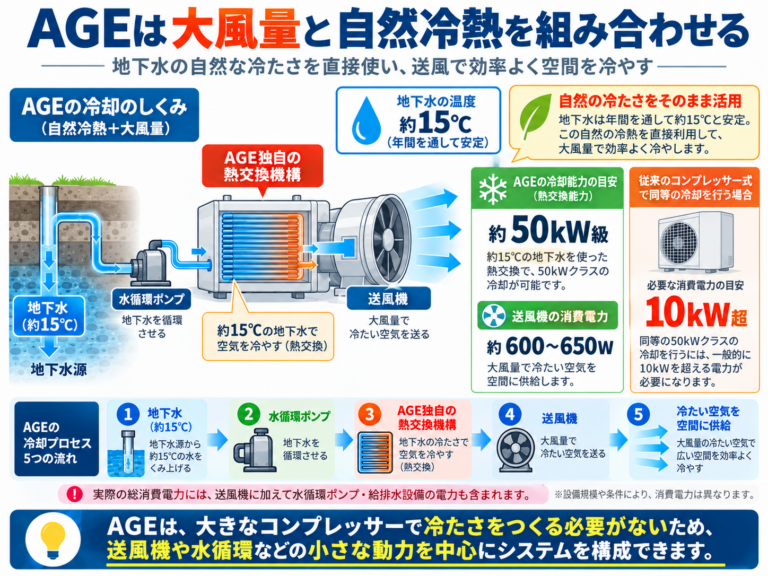
This is because it simultaneously utilizes heat exchange through direct contact between water and air, and the cooling effect of water vaporization.
Normally, when groundwater at 15°C is brought into contact with air at 35°C, heat is transferred from the warmer air to the cooler water.
In this process, the air is cooled, and the water absorbs heat from the air.
This is "direct gas-liquid heat exchange," which utilizes the temperature difference between air and water.
However, heat exchange is not the only thing happening in the AGE device.
During the process of water coming into contact with air, some of the water vaporizes and moves into the air as water vapor.
When water changes from a liquid to a gas, a process called "heat of vaporization" occurs, which absorbs heat from the surroundings.
AGE actively utilizes this vaporization phenomenon, simultaneously employing a cooling effect through the heat of vaporization in addition to heat exchange due to the temperature difference between water and air.
Even water at low temperatures can vaporize.
When we talk about water vaporizing, many people might think of the phenomenon of water boiling at 100°C.
However, water vaporization does not necessarily only occur at 100°C.
Just as laundry dries at room temperature, water evaporates into the air even at relatively low temperatures.
The ease of evaporation depends not only on the water temperature, but also on the temperature and humidity of the air it comes into contact with, the airflow, and the surface area of contact between the water and the air.
AGE creates conditions that facilitate vaporization even at low temperatures by optimizing the way water and air come into contact and their flow.
This enables air conditioning that combines direct gas-liquid heat exchange with cooling through vaporization, while utilizing relatively low-temperature water such as groundwater.
A mechanism that allows circulating water to continue working efficiently.
Generally, if you keep cold water in contact with warm air, the water will absorb heat from the air and its temperature will gradually rise.
As the water temperature rises, the temperature difference with the air decreases, and the cooling capacity also decreases.
In the AGE device, water vaporization also occurs simultaneously during this process.
Since heat is required when some water vaporizes, a complex transfer of sensible and latent heat occurs between the circulating water and the air it comes into contact with.
In other words, the cooling mechanism isn't simply a one-way heat exchange where "warm air warms cold water," but also incorporates the phenomenon of heat transfer through water evaporation.
By combining these two actions, the system is configured to efficiently cool the circulating water while suppressing the temperature rise.
The actual circulating water temperature is determined by factors such as air temperature and humidity, water replenishment conditions, and circulation rate, but AGE utilizes these conditions to enhance its cooling performance.
Recycle water with minimal replenishment.
The AGE device is not a system that simply passes water through once and then discards it.
The water can be circulated within the device and reused repeatedly.
During the circulation process, some water is lost through evaporation. Additionally, to maintain water quality, a portion of the concentrated water is discharged and replaced with fresh water as needed.
Depending on the equipment configuration and operating conditions, some systems can operate with approximately 20 liters of makeup water per hour.
This water circulation system can be utilized not only when using natural cooling methods such as groundwater, but also in locations where groundwater is unavailable, by combining it with small chillers or similar devices.
Instead of using large amounts of water and discarding it, the system will maintain cooling capacity by repeatedly reusing a small amount of replenishment water.
This is another important feature of AGE's air conditioning system.
Combining natural phenomena can lead to significant energy savings.
In typical air conditioners, a considerable amount of mechanical power is required to compress the refrigerant and transfer heat.
In contrast, AGE reduces its reliance on mechanical equipment by combining the temperature difference between water and air, the heat of vaporization of water, and naturally occurring cold energy.
What is particularly important is that these phenomena do not operate independently, but rather work in combination within a single device.
Direct heat transfer from air to water, and heat transfer through the vaporization of water.
These two methods are efficiently combined to cool a large volume of air while circulating water.
Furthermore, relatively small amounts of power are used for necessary ventilation and water circulation, and only the insufficient cooling is supplemented by mechanical equipment as needed.
The system utilizes the natural phenomena of heat transfer and water vaporization as the primary components of air conditioning.
This is AGE's unique cooling mechanism and a crucial technological foundation that enables significant energy savings.
 English
 日本語
 Tiếng Việt
 Português do Brasil