
6. Multistage heat exchange and the concept of humidity — Why cooling effect can be achieved even at 90% humidity
Why AGE employs multi-stage heat exchange
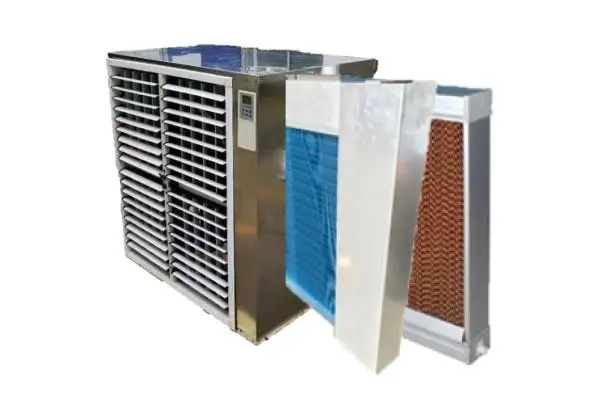
AGE's air conditioning system employs a method that performs heat exchange between water and air in multiple stages.
This is to effectively utilize two processes—water vaporization and direct gas-liquid heat exchange—depending on the state of the air.
For example, in a two-stage heat exchanger, the first stage brings air and water into direct contact, simultaneously performing cooling through water vaporization and direct heat exchange due to the temperature difference.
During this process, the air temperature may decrease, and the relative humidity may rise to around 90%.
In the second stage, because the humidity is already high, water evaporation becomes less likely.
On the other hand, if there is a temperature difference between the air and the water, direct gas-liquid heat exchange will continue.
In other words, the first stage combines vaporization and direct heat exchange, while the second stage primarily utilizes the function of direct heat exchange.
AGE utilizes this change in air quality and combines multiple heat exchange stages to achieve efficient cooling.
You shouldn't judge solely based on the figure of 90% humidity.
This raises a question.
"If the humidity reaches 90%, wouldn't the air become damp and actually more uncomfortable?"
That's the question.
To understand this problem, you need to know the difference between relative humidity and the actual amount of water vapor contained in the air.
Generally, when we say "90% humidity," we are referring to relative humidity.
Relative humidity is the ratio of the amount of water vapor currently contained in air at a given temperature to the amount of water vapor that the air can hold in a saturated state.
The important point is that the amount of water vapor that air can hold varies greatly with temperature.
Warmer air can hold more water vapor.
On the other hand, in colder air, the amount of water vapor that can be contained in a saturated state is simply less.
Therefore, even if the relative humidity of cold air is 90%, the actual amount of water vapor it contains may be less than that of hotter air.
In other words, a high relative humidity figure alone does not mean that there is a large amount of moisture in the air.
Even typical air conditioners create a high-humidity environment when cooling.
This phenomenon can also be observed in the cooling function of typical air conditioners.
In an indoor unit of an air conditioner, the temperature of the air is lowered by bringing it into contact with a cold heat exchanger.
When air is cooled, its relative humidity increases, and near the surface of the heat exchanger, the humidity can reach a near-saturation point of almost 100%.
Furthermore, when the air is cooled to below the dew point temperature, some of the water vapor condenses and is removed as water droplets.
This is why dehumidification also occurs when you use an air conditioner for cooling.
Therefore, the fact that cooled air has high relative humidity is not a special phenomenon in terms of air conditioning.
Whether using an air conditioner or an AGE heat exchanger, to accurately evaluate the air before and after cooling, it is necessary to consider temperature, relative humidity, and absolute humidity together.
The important thing is to evaluate both the temperature and the actual moisture content together.
For example, even with the same humidity level of 90%, the amount of water vapor in the air will differ significantly between a temperature of 35°C and 25°C.
Air at 35°C and 90% humidity contains a very large amount of water vapor, while air at 25°C and 90% humidity contains less water vapor.
Therefore, when comparing air conditions, it is important to check not only the relative humidity figures, but also the temperature and absolute humidity.
Furthermore, in devices where water and air are in direct contact, the amount of moisture in the air may increase due to evaporation, or condensation may occur depending on the cooling conditions.
Based on these phenomena, AGE combines heat exchange methods while considering the required cooling capacity and the state of the supplied air.
Because it's a multi-stage system, heat exchange can be adapted to the air conditions.
AGE's multi-stage heat exchange is not simply two identical cooling devices placed side by side.
In the first stage, vaporization and direct heat exchange are used to change the temperature and humidity of the air.
In the second stage, the altered air is cooled primarily through direct heat exchange.
Thus, a key feature is the utilization of different heat transfer mechanisms at each stage.
Furthermore, the cooling capacity of the air needs to be evaluated not only by the outlet temperature, but also by changes in airflow and humidity.
Evaporation, direct heat exchange, temperature, humidity, and airflow. Combining these into a single air conditioning system.
This is the concept behind AGE's multi-stage heat exchange technology, and it is an important mechanism for achieving both high airflow and high energy efficiency.

 English
 日本語
 Tiếng Việt
 Português do Brasil