
7. Energy-saving air conditioning that can be achieved even without groundwater — Combined use of small chillers and air conditioners. AGE technology can be used even in places without groundwater.
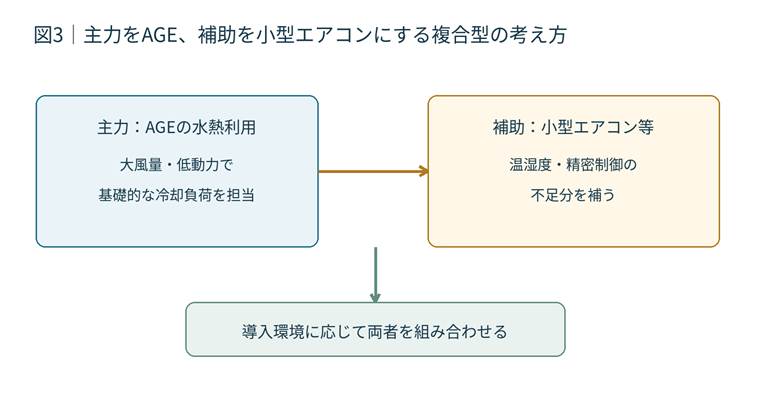
A hybrid air conditioning system that primarily uses AGE (Advanced Glycation End) and supplements it with small air conditioners, etc.
AGE's energy-saving air conditioning technology is not solely based on the use of groundwater.
In areas with abundant groundwater resources, direct use of its stable cooling energy makes it possible to provide cooling with extremely low electricity consumption.
However, in many cases, factories and large facilities in urban areas cannot utilize groundwater.
At AGE, in order to achieve energy-saving air conditioning even in such locations, we employ a circulating system that combines a small chiller with our unique gas-liquid direct heat exchange device.
In this method, the water required for cooling is circulated within the device, utilizing the cooling effect of water vaporization and direct heat exchange between the gas and liquid.
Furthermore, any cooling that is insufficient through natural processes is supplemented by a small chiller.
In other words, instead of relying entirely on the chiller for cooling, the AGE's heat exchange mechanism is the primary component, with the chiller playing a supporting role to provide the necessary cooling capacity.
Small chillers work only when and how much you need them.
In typical compression-type air conditioning systems, mechanical equipment that compresses the refrigerant plays a central role in obtaining the required cooling capacity.
In contrast, AGE's hybrid systems actively utilize the cooling effect of direct heat exchange and vaporization between water and air, allowing for configurations that reduce the amount of cooling required by the chiller.
For example, when a small chiller is combined with a large-volume AGE air conditioning system, the chiller operates only as much as necessary to maintain the temperature of the circulating water.
If the cooling conditions are met, it is not necessary to run the chiller at maximum capacity at all times.
By controlling the operation according to the temperature of the circulating water and the air conditioning load, the chiller's operating time and load can be reduced.
It is not necessary to run a large compressor constantly to obtain a large cooling capacity.
This is a major feature of AGE's integrated air conditioning system.
Compared to conventional air conditioning, it can aim for a 70-80% reduction in energy consumption.
AGE's integrated air conditioning system offers a configuration and operating conditions that, even when groundwater is unavailable, can aim for a 70-80% reduction in energy consumption compared to conventional air conditioning.
This is not simply a smaller version of a typical air conditioner.
This approach reduces the burden on mechanical cooling by combining water vaporization, direct gas-liquid heat exchange, high-volume airflow, and water circulation.
Actual energy savings will vary depending on factors such as the required cooling capacity, outside air temperature and humidity, circulating water temperature, and equipment operating time.
By configuring a system suited to each facility, we can pursue high energy-saving performance.
A regular air conditioner can also be used as a supplement.
AGE is not rejecting conventional air conditioning technology.
Rather, we believe that by combining the roles that each technology excels at, we can create a superior air conditioning system.
For example, in large factories and greenhouses, AGE's high-volume air conditioning systems are primarily used to efficiently handle the heat load of the entire space.
Furthermore, in areas requiring particularly low temperatures or where strict temperature and humidity control is necessary, small air conditioners or heat pumps are used as supplementary equipment.
With this configuration, it's not necessary to handle the entire cooling load with large air conditioners alone.
AGE is responsible for the basic cooling of the space, and air conditioners supplement any shortcomings.
The AGE (Advanced Glycation End Products) will be the main component, with air conditioning used as a supplement.
This is AGE's concept of a combined energy-saving air conditioning system.
The larger the facility, the greater the value of integrated air conditioning systems.
Large facilities such as factories, greenhouses for horticultural facilities, livestock barns, and gymnasiums have different air conditioning challenges than typical houses and offices.
In facilities with large spaces and high ceilings, a large amount of equipment capacity is required to cool all the air uniformly.
Furthermore, in facilities where large amounts of outside air enter through ventilation, the cooled air is expelled outdoors, requiring a different air conditioning design than that of typical enclosed spaces.
In facilities like these, it can sometimes be more effective to deliver a large volume of cool air to the areas where it's needed rather than lowering the temperature of the entire space unnecessarily.
AGE combines high-volume airflow technology with water-based heat exchange technology to create air conditioning systems tailored to the specific needs of each facility.
Furthermore, by utilizing existing air conditioners and chillers as auxiliary equipment, it is possible to leverage the advantages of both new and existing equipment.
The necessary cooling comes from nature. Only the deficiency is supplemented by machinery.
The underlying principle behind AGE's air conditioning technology is very simple.
Where groundwater is available, the cold energy of the groundwater is used directly.
In areas without groundwater, small chillers are used to compensate for the shortage by utilizing the vaporization of water and direct heat exchange.
Furthermore, in locations requiring more precise temperature control, a combination of small air conditioners and heat pumps can be used.
Instead of relying entirely on large-scale machinery, we should differentiate between the parts that can be handled by natural phenomena and the parts that should be handled by machinery.
We make the most of natural forces and only use machines where necessary.
This combination allows AGE to propose energy-saving air conditioning systems that can be used in a variety of facilities, regardless of the presence or absence of groundwater.
 English
 日本語
 Tiếng Việt
 Português do Brasil